

Sales funnels
The pages, the form and the follow-up, built as one thing.
A funnel is a built asset: a short chain of pages and messages that carries one kind of visitor from one source to one action. Whether your business needs one is a question this site answers elsewhere. This page is about how the thing is made, and where it leaks.







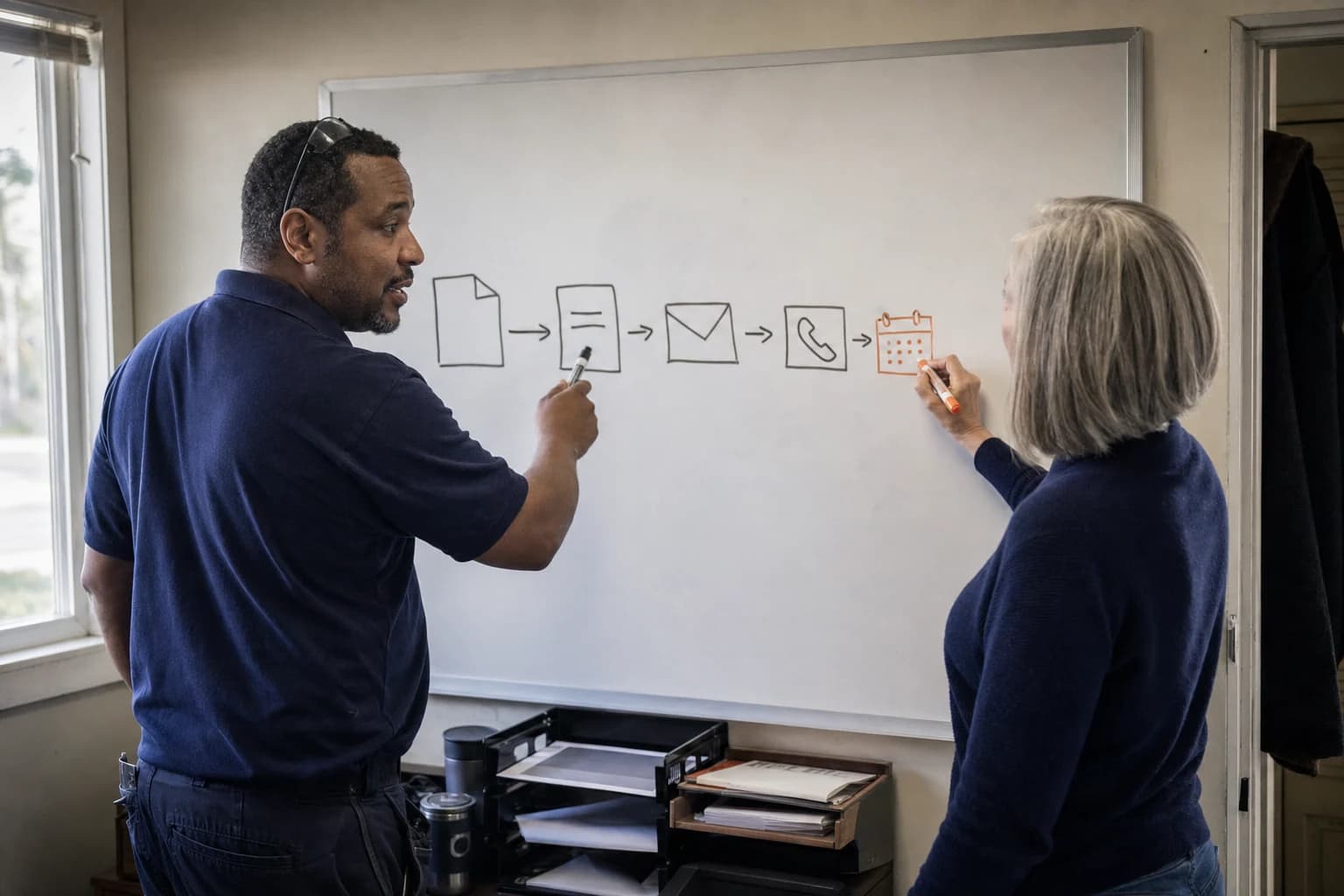
How is a sales funnel built for a local business?
In seven pieces, built in order. A traffic source that has been chosen, not assumed. A landing page that repeats the promise the source made. A form or a booking calendar that asks for the least it can. A confirmation page that says what happens next. Reminders for the appointment that was booked. A follow-up sequence for the people who did not book. And a measurement at every step, so that when the numbers are wrong you can see which step is losing people.
The offer inside it has to be honest, because the Federal Trade Commission's rules on truthful advertising apply to a landing page exactly as they apply to the ad that pointed at it.
Some businesses do not need one. A good service page and a phone that is answered is a funnel with two steps, and for an urgent trade it is often the better one.
Written and maintained by the VIS Mountain team. Last reviewed . The sources behind it are listed below.
What is actually being built
Strip the word of its mystique and a funnel is a landing page with a form or a calendar on it, a page that appears after the form, and the messages that go out afterwards. The build is those things, connected, tracked and pointed at one source of traffic.
One source, because a page built for everybody is a service page, and the site already has those. A funnel is narrower on purpose. It is for the person who clicked an advertisement for a specific offer, or scanned a code on a mailer, or followed a link in an email, and it continues the sentence that brought them there.
Read the full breakdown: What is actually being builtHide the full breakdown: What is actually being built
One action, because a page that offers three next steps gets fewer of any of them. The action is usually a booked appointment, a request for a quote or a phone call. It is chosen before anything is designed.
And a plan for the people who do not take the action, because on any page that is most of them. The follow-up is not an add-on to the funnel. It is the half of the funnel that works while nobody is watching.
It is not the right tool for an emergency service. Somebody with a burst pipe wants a number and an answer, and every extra step is a step toward the next result on the page.
How the build runs, in order
The order is the point. Designing the page before the source, the offer and the action are settled produces a handsome page with nothing to do.
Settle the source and the offer
Which traffic will arrive, from what advertisement or link, and what it was promised. The offer has to be one you can deliver to every person who accepts it, on the terms the page states, with nothing material held back for the fine print.
- One source per funnel, so the message can match it
- One action, chosen before any design
- An offer the business has agreed to honour as written
Build the landing page
A headline that repeats the promise the visitor clicked, the specific reasons to believe it, the answer to the one objection most visitors have, and the form or calendar within reach without scrolling. Nothing else: no menu, no links to elsewhere on the site, no second offer. Google Ads describes landing page experience as how relevant and useful the page is to the people who click the ad, and it is one of the three components of Quality Score, so the page is judged by the platform as well as by the visitor.
Add the form or the calendar
A form asks for the least it can and still qualify the enquiry: usually a name, a way to reach the person, and what they want. A calendar removes a whole step by letting the person choose a slot themselves. Every extra field has to earn its place, because each one is a reason to stop.
See the remaining steps: How the build runs, in orderHide the remaining steps: How the build runs, in order
Write the confirmation page
The page after the form is the most neglected page in most funnels and one of the most read. It confirms what was sent, says what happens next and when, gives a phone number for anything urgent, and is where the conversion is measured.
Set the reminders
For anybody who booked: a confirmation by email, a reminder a few days out and one the day before, sent automatically. Reminders are the cheapest reduction in no-shows available, and they carry no promotion, which keeps them on the transactional side of the email and texting rules.
Build the follow-up for people who did not book
For anybody who enquired and went quiet: a short sequence, a text back, an email, a reminder, that stops the moment they reply, book or opt out. It runs only to people who gave you that number or address for the purpose, and it is written by a person, in the business's own voice.
Measure every step
Arrivals, form starts, form completions, confirmations, bookings kept, and follow-up replies, each recorded as its own event. This is what makes the funnel repairable. Without it a poor month is a mystery. With it, the step that is leaking is visible in an afternoon.
Dash Funnels, the VIS Mountain product for funnels, landing pages and CRM follow-up, is what ours are usually built on. It works alongside the booking or practice system you already run, and the design is the same whichever tool holds it.
The path the funnel has to hold
This is the funnel with the decoration removed. Every box is a step, and every step is somewhere to lose a person.
The drawing starts at a search. Swap that for an advertisement, a mailer or an email and the shape is identical, which is why the build does not change much by source. What changes is the words on the page.
What asking for too much costs
The closest well documented equivalent to a local business form is an online checkout. Baymard Institute aggregates abandonment studies and surveys the reasons shoppers give for leaving.
SourceCart abandonment rate statistics, Baymard Institute, 2025, 50 studies
A quote request is not a checkout, and the numbers should not be transplanted. The direction transfers: every field, every account, every extra page is a reason to stop, and most funnels ask for too much too soon.
Where funnels fail in practice
Most failed funnels are not badly designed pages. They fail on one of these, and the measurement at each step is what tells you which.
- Poor traffic. A perfect page shown to the wrong people converts nobody, and a funnel cannot fix targeting.
- A slow human reply. The form worked, the confirmation went out, and nobody called back until Thursday. The funnel delivered and the business dropped it.
- Asking for too much too soon. Eleven fields, a date of birth, an insurance number and a required account, on a page whose only job was to start a conversation.
- A page that does not repeat the promise. The advertisement said one thing, the page opens with another, and the visitor assumes they clicked wrong.
- A confirmation page that says thank you and nothing else, so the person does not know whether anyone will call.
See the full checklist: Where funnels fail in practiceHide the full checklist: Where funnels fail in practice
- Follow-up that keeps running after the person has booked, or after they have replied, which is the fastest way to turn a warm enquiry cold.
- Nothing measured between arrival and booking, so nobody can say where the loss is.
- An offer the front desk had not heard of, so the first phone call contradicts the page.
- A funnel built for an emergency service, where the only thing wanted was a number.
The second item is the one to check first. It is invisible from inside the marketing report and it is the most common.
Honest offers, consent, and healthcare
The Federal Trade Commission's position is that claims in advertisements must be truthful, cannot be deceptive or unfair, and must be evidence-based, and a landing page is an advertisement. The FTC's small business guide adds the specifics that matter on a funnel page: a free offer tied to a purchase must disclose its conditions clearly and conspicuously, a money-back guarantee is not a substitute for evidence, and fine print cannot be used to contradict the headline.
The regulator has also named the tricks. Its 2022 report on dark patterns describes countdown timers designed to make consumers believe they only have a limited time to purchase when the offer is not actually time-limited, and terms buried where nobody sees them before buying. We do not build fake timers, invented scarcity or pre-ticked boxes, whatever they are reported to do to a conversion rate.
Read the full breakdown: Honest offers, consent, and healthcareHide the full breakdown: Honest offers, consent, and healthcare
Follow-up has its own rules. Commercial email sits under the CAN-SPAM Act, with its requirements for accurate headers, a postal address and an opt out honoured within ten business days. Texts and calls sit under Federal Communications Commission rules, and its consumer guide says commercial texts require written consent and that a person may opt out at any time in any reasonable manner. The consent is collected on the form, in plain words, and recorded.
Healthcare adds a layer that is not ours to interpret. A confirmation, a reminder or a follow-up must not reveal that somebody is a patient or what they enquired about, and the HIPAA Privacy Rule restricts using patient information for marketing without written authorisation. The practice is responsible for its own compliance. We build to the stricter reading by default and point to the regulator's guidance where a question goes beyond that.
How a funnel is measured, and what cannot be promised
The report is a chain of ratios: arrivals to form starts, starts to completions, completions to bookings, bookings to appointments kept, and follow-up sends to replies. Reading the chain from left to right shows the first step where the ratio is poor, and that is the step to fix. Fixing any other step first is guesswork.
Two numbers sit outside the chain and matter more than anything inside it. The cost of an arrival, which is the source's number rather than the funnel's. And what a booking is worth to you, which decides how much of that cost the funnel can afford. The funnel's job is to make the ratio between those two acceptable.
Read the full breakdown: How a funnel is measured, and what cannot be promisedHide the full breakdown: How a funnel is measured, and what cannot be promised
At local business volumes, formal split testing rarely reaches a reliable answer, and we will say so rather than run one for the appearance of rigour. What works instead is changing one substantial thing at a time and reading the chain over a real period.
What cannot be promised is a conversion rate or a number of bookings. Those depend on the offer, the source, the price and how quickly a person calls back, and the last of those is entirely inside your business.
We do not publish a price for this piece of work on its own, because the right scope depends on what already exists. What is published is the bundle pricing: 2,400, 3,600 or 4,800 dollars a month depending on which channels are running. You can read the full breakdown on the pricing page, and you will get an exact number in writing before anything starts.
How this connects to the rest
A funnel is what the paid channels point at. Google Ads and Meta ads both buy the arrival, and the funnel decides what the arrival becomes.
The first page of it is a landing page, and landing page design is sold on its own where the form and the follow-up already exist.
The follow-up half runs on marketing automation and lands in whatever CRM implementation put in place. Without a record of who enquired, there is nothing to follow up.
The measurement is conversion tracking, and where a funnel produces phone calls it needs call tracking to count them.
And it sits under web design and development because it is a built thing, with the same speed, accessibility and mobile obligations as every other page on the site.
Send us the page your best advertisement points at.
We will follow it through the form to the confirmation and the first follow-up, and tell you which step is losing people. If the honest answer is that you need a better service page and a phone that is answered, we will say that instead.
Straight answers.
Do we need a funnel, or just a good website?
Some businesses need only a good page and an answered phone, and an urgent trade is usually one of them. A funnel earns its place when one source is sending one kind of visitor for one offer, and the site's general pages are not built for that.
The site has a separate page on what a funnel is and whether a business needs one. This page assumes the answer was yes.
How many pages does a funnel have?
Usually two: the landing page and the confirmation page. The rest is messages, not pages.
Long chains of pages with an upsell on each one belong to a different kind of business. For a local service the shortest route to the calendar wins.
What should the form ask for?
The least that lets you reply usefully: a name, one way to reach the person, and what they want. Anything else is asked in the conversation that follows.
Where the funnel ends in a calendar rather than a form, the person chooses a slot and a whole step disappears.
Can we use a countdown timer or a limited spots message?
Only if it is true. The Federal Trade Commission's dark patterns report names countdown timers on offers that are not actually time-limited as a deceptive design, and the same logic applies to invented scarcity.
A real deadline, stated plainly, is fine. We will ask what happens when the timer reaches zero, and if the answer is nothing, it does not go on the page.
Why did our funnel stop working?
Usually one of three things: the traffic changed, the reply slowed down, or the offer stopped being true. The chain of measurements shows which, because each of those breaks a different step.
If nothing was measured between arrival and booking, the honest first job is to add that measurement and wait for a real period of data.
Does a funnel work for a medical practice?
It can, with constraints. The offer must be honest and substantiated, the form must collect only what is needed, and nothing sent afterwards may reveal that the person is a patient or what they asked about.
The practice is responsible for its own compliance, and the Department of Health and Human Services publishes guidance on marketing under the Privacy Rule. Anything near the line goes to your own counsel before it goes live.
Where this comes from.
Primary documentation and published research behind the guidance on this page.
- FTC truth in advertising (opens in a new tab)
- Advertising FAQs: a guide for small business, FTC (opens in a new tab)What substantiation a claim needs, whichever platform it runs on.
- FTC report on dark patterns designed to trick and trap consumers, 2022 (opens in a new tab)Fake countdown timers and buried terms, named by the regulator.
- Landing page, Google Ads Help (opens in a new tab)What Google Ads means by a landing page and how its experience affects Quality Score.
- Baymard Institute cart abandonment research (opens in a new tab)
- FCC rules on unwanted calls and texts (opens in a new tab)
Talk to the team
A short call, a look at how the business currently shows up, and a straight answer on what we would do first.