

Print and collateral
Print that is still worth the paper, and can be measured.
Most print is ordered because it always was, and judged by whether it looked nice when the box arrived. The useful version is narrower: a short list of pieces that reach a person at a moment a screen does not, designed to the same system as the website, carrying the same phone number as the listings, and built so somebody can tell whether they worked.


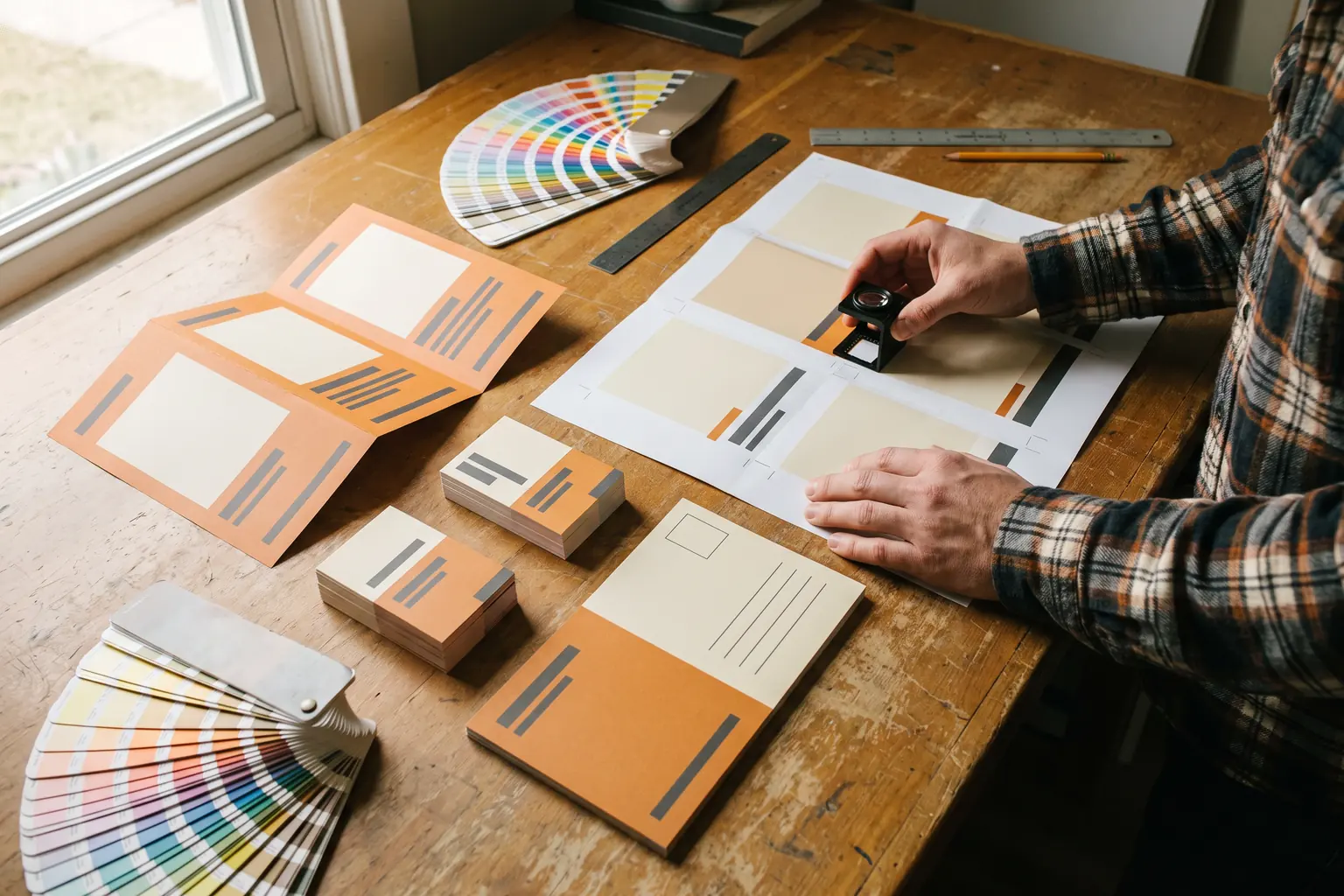
What print materials does a local business still need?
Fewer than it used to, and the ones it still needs are those that reach a person where a screen does not: a card handed over at the end of a job, the signage that says which door to use and when you are open, a leaflet a patient takes home to think about, the vehicle parked outside a neighbour's house all afternoon, and a mailer to the streets around a new location.
What it no longer needs is anything printed out of habit: the folded brochure that repeats the website, the presentation folder nobody opens, the flyer with a slogan and no phone number.
Every piece that is printed should use the same identity as the website, carry exactly the name, address and phone number the listings carry, and be measurable, with a dedicated number or a tagged QR code where the piece is a campaign rather than a fixture.
Written and maintained by the VIS Mountain team. Last reviewed . The sources behind it are listed below.
Print is the channel nobody measures
A search campaign reports every click. A box of five thousand leaflets reports nothing, which is why print is the first budget cut and the last one anybody can defend.
That is a design problem as much as a measurement one. A leaflet with the main office number on it produces calls that look like every other call. A leaflet with a number used nowhere else, or a QR code that lands on a page tagged with the campaign, produces calls and visits that can be counted alongside the advertising.
The other half of the job is consistency. Print is where a business most often drifts: an old logo on the cards, a different blue on the van, a phone number on the window that was changed on the website two years ago. Every printed piece is made from the same identity system as the site and checked against the business record the listings use.
What we deliver is print-ready artwork any commercial printer, sign maker or wrap installer can run, with the specification written down. Who prints it is your choice.
What is still worth printing, and what is not
The test for each piece is whether it reaches somebody at a moment a screen cannot, and whether it tells them what to do next.
| Item | Worth printing when | Skip when |
|---|---|---|
| Business cards | Handed over at the end of a job or a consultation, with one number and one address | Ordered by the thousand so the design can never be corrected |
| Brochures and rack cards | A considered service the customer takes home to think about, or a referral partner hands out | It repeats the website with no reason to keep it |
| In-office and window signage | Wayfinding, hours, parking, what to bring, how to leave a review | A mission statement in a frame |
| Vehicle graphics | The name, the service, the number and any licence number, readable across a street | A full wrap with a tagline and a number too small to read at a junction |
| Direct mail | The streets around a new location, a season that repeats, an offer with a deadline | A purchased list, or a piece with nothing to track it |
The vehicle row is the one most often got wrong. A van is seen for seconds at a distance, and the design has to survive that before it can afford to be clever.
How a print job runs
Most of this is discipline rather than design. The design is the quick part.
Inventory what is printed now
Every card, form, sign, sticker and leaflet in circulation, photographed, with a note of which logo version and which phone number each one carries. Most businesses find at least one piece carrying a number or an address they no longer use.
Apply the identity system, or set one
Colour in the print process the piece will use, the typefaces the licence covers for print, the correct logo version for the substrate, and the spacing rules the website already follows. If no system exists, print is a poor place to invent one, and the brand identity work comes first.
Verify the details against the listings
The name, address, phone number and hours on the artwork are copied from the record the Google Business Profile and the directories carry, not typed from memory. Google asks that a business be represented as it is consistently represented in the real world, across signage, stationery and other branding, and a sign that disagrees with the listing is a small inconsistency people notice.
See the remaining steps: How a print job runsHide the remaining steps: How a print job runs
Build the tracking in
For anything that is a campaign, a dedicated phone number that is used nowhere else and a QR code whose destination carries campaign tags, pointing at a page that makes the same offer as the piece. For anything permanent, the real number, because a rented tracking number on a van outlives the subscription.
- A short, readable web address printed beside the QR code, for people who will not scan
- One offer per piece, so a response can only mean one thing
- The number and the page live before the print run
Prepare the file properly
Colour mode for the process, bleed where the design meets the edge, resolution checked at final size, a vector logo, fonts outlined or embedded, and text kept clear of trim and folds. This is what stops the reprint.
Proof, then hand over
A physical proof for anything at quantity or at large size, because screens flatter colour. Then the artwork and the specification go to whichever printer you choose, and the source files stay yours.
Step three is the one that separates print from the rest of the marketing. It is also the step most often skipped, because the number on the old card looked right.
Before anything goes to print
Every item on this list has caused somebody a reprint. The last two have caused worse.
- Colour mode matches the process, and spot colours are named where the printer needs them rather than approximated.
- Bleed is included wherever the design reaches the edge, to the printer's stated measurement.
- Images hold their resolution at final size. A photograph that fills a phone screen is rarely large enough for a window graphic.
- The logo is vector, in the version the identity system specifies for that background, including a single colour version where the process demands one.
- Fonts are outlined or embedded, so nothing is substituted on the printer's system.
See the full checklist: Before anything goes to printHide the full checklist: Before anything goes to print
- Text sits inside the safe area, away from trim and folds, at a size readable at the distance the piece is seen from.
- The phone number, address, hours and web address are checked against the listings by somebody who did not type them.
- Any licence, registration or certification number the trade is required to display is present and correct.
- The tracking number is one you intend to keep for as long as the piece exists.
- Nothing on the piece makes a claim that the website could not substantiate.
The phone number check is the cheapest item here and the one that most often gets skipped. A transposed digit on five thousand postcards sends a month of calls to a stranger.
Where a printed piece reports to
A mailer is judged by the same plan as a search advertisement, provided it was given a way in.
Mail without a list
The United States Postal Service's Every Door Direct Mail delivers a piece to every address on the carrier routes you choose, addressed to Postal Customer, so no mailing list and no patient or customer data is involved. These are the published terms of the retail version used by small businesses.
SourceEvery Door Direct Mail, USPS, EDDM Retail terms as published
Routes are chosen on a map by address, city or ZIP Code, and can be filtered by age, household size and income using Census data. Pieces are flats up to a published weight, with the postage price on the same page. The drop-off is at a Post Office, with the mail bundled and the forms printed from the order.
The rules that reach paper
The Federal Trade Commission's truth in advertising rules apply to a postcard, a poster and a van exactly as they apply to a search advertisement: claims must be truthful, cannot be deceptive or unfair, and must be evidence-based. A results claim on a leaflet needs the same substantiation as one on a landing page, and print is harder to correct.
Healthcare mailers touch the privacy rule. The Department of Health and Human Services explains that, with limited exceptions, a patient's written authorisation is needed before their health information is used for marketing, that a practice may not sell its patient list to a third party for that party's marketing without each patient's authorisation, and that a mail house working from a patient list is a business associate needing the appropriate agreement. Some communications about a practice's own health-related services fall inside the exceptions, and deciding which is a job for the practice and its counsel, not for a designer. A route-based mailer addressed to every household uses no patient data at all, which is the simplest position, and the practice remains responsible for its own compliance.
Read the full breakdown: The rules that reach paperHide the full breakdown: The rules that reach paper
Trades have their own display rules, which vary by state. California's Contractors State License Board, for one, requires the licence number on all forms of advertising, business cards and vehicle lettering included, and sets minimum letter sizes for commercial vehicles. We check the requirement for your state and trade before the artwork is finalised, and the licence number is on the checklist above.
The mark itself is a trademark question. The United States Patent and Trademark Office is clear that the registered symbol may only be used once a trademark is federally registered, and only for the goods or services listed in the registration. A sign or a wrap is the most expensive place to discover a conflict, so the search happens before the artwork, and anything that looks risky goes to a trademark attorney.
How print is judged, and where that stops
A campaign piece is judged by the calls to its number, the scans of its code and the enquiries on its page, all tagged with the campaign and counted in the same place as everything else. Google's own guidance for campaign links is to always set the source, the medium and the campaign name, and a QR code's destination carries all three so the visit is attributed to the mailer rather than to direct traffic.
A fixture is not judged that way, and it is dishonest to pretend otherwise. Signage and vehicles carry the real number, so their calls cannot be separated from the rest. They are judged by whether people can find the building and read the van, by asking new customers how they heard of you, and over time by branded search.
Read the full breakdown: How print is judged, and where that stopsHide the full breakdown: How print is judged, and where that stops
The one habit that makes print measurable is asking. A single question at the first contact, recorded in the same system that holds the calls and forms, tells you more about a van than any amount of guessing.
We do not publish a price for this piece of work on its own, because the right scope depends on what already exists. What is published is the bundle pricing: 2,400, 3,600 or 4,800 dollars a month depending on which channels are running. You can read the full breakdown on the pricing page, and you will get an exact number in writing before anything starts.
How this connects to the rest
Print applies the brand identity system that logo design and identity work produce, and it sits beside graphic design, which covers the digital and the day to day. This page is the physical end of the same job.
The details on every piece come from local listings management, which holds the one correct record, and the phone number on a campaign piece comes from call tracking, so a call from a postcard is attributed like a call from an advertisement.
The QR code lands on a page, which is landing page optimization work, and the tag it carries is set up by conversion tracking, so a mailer and a search campaign report into the same plan.
Where a piece goes to a patient or a customer list, marketing automation and email marketing are usually the cheaper first step, and the compliance questions are the same ones.
Photograph everything you currently print.
Cards, forms, signs, the van, the window. Send us the photographs and we will tell you which pieces are worth keeping, which carry the wrong details, and which could be measured.
Straight answers.
Do you print it?
No. We produce print-ready artwork with a written specification, and you place it with the commercial printer, sign maker or wrap installer you prefer.
We will tell you exactly what to ask them for, including colour mode, bleed and proofing, and we check their proof if you want a second pair of eyes.
Do we need a brochure?
Only if somebody takes it home to think with, or a referral partner hands it out. A considered treatment, a legal process or a large home project can justify one.
A brochure that repeats the website has no job. A short rack card with one clear next step usually does more.
Should the van have a tracking number on it?
No. Tracking numbers are rented, and when the subscription lapses the number is recycled to somebody else while the van keeps driving around with it.
Anything permanent carries the real number. Tracking numbers belong on time limited pieces such as a mailer or a leaflet drop.
How does a QR code get measured?
By where it points. The destination carries campaign tags naming the source, the medium and the campaign, so the visit shows up under the mailer rather than under direct traffic, and the page it opens makes the same offer as the piece.
Print a short, readable address beside it as well. Some people will type rather than scan, and the code should not be the only way in.
Can a medical practice send a mailer?
A route-based mailer addressed to every household uses no patient information, which is the simplest position. A mailing to your own patient list is governed by the privacy rule's marketing provisions, and some communications about your own services fall within its exceptions.
Deciding which applies is for the practice and its counsel, with the Department of Health and Human Services guidance as the reference. We design to the stricter reading and flag anything that needs that decision.
Can you match print colours to the website exactly?
Closely, not exactly. Screens emit light and ink reflects it, so the identity system specifies the colour separately for screen, process printing and spot colour, and the printed result is judged against a physical proof.
If your brand colour was chosen on a screen and has never been printed, expect a small adjustment the first time, and expect the proof to be the thing that settles it.
Where this comes from.
Primary documentation and published research behind the guidance on this page.
- Every Door Direct Mail, United States Postal Service (opens in a new tab)Mail to every address on chosen carrier routes, with no list and no permit for the retail version.
- FTC truth in advertising (opens in a new tab)
- HIPAA and marketing, U.S. Department of Health and Human Services (opens in a new tab)
- United States Patent and Trademark Office, trademark basics (opens in a new tab)
- Advertising Guidelines for Contractors, California Contractors State License Board (opens in a new tab)One state's example of licence numbers required on every advertisement, vehicles included.
- Collect campaign data with custom URLs, Google Analytics Help (opens in a new tab)The campaign parameters a QR code's destination should always carry.
Talk to the team
A short call, a look at how the business currently shows up, and a straight answer on what we would do first.