

Video production
Marketing video that is made, not filmed.
Nobody from VIS Mountain arrives with a camera. Nothing is filmed on location. What we produce is video that is built rather than shot: animation, motion graphics, screen recordings and cuts assembled from footage, photographs and licensed material that already exist. For most local businesses that is the more practical kind anyway.


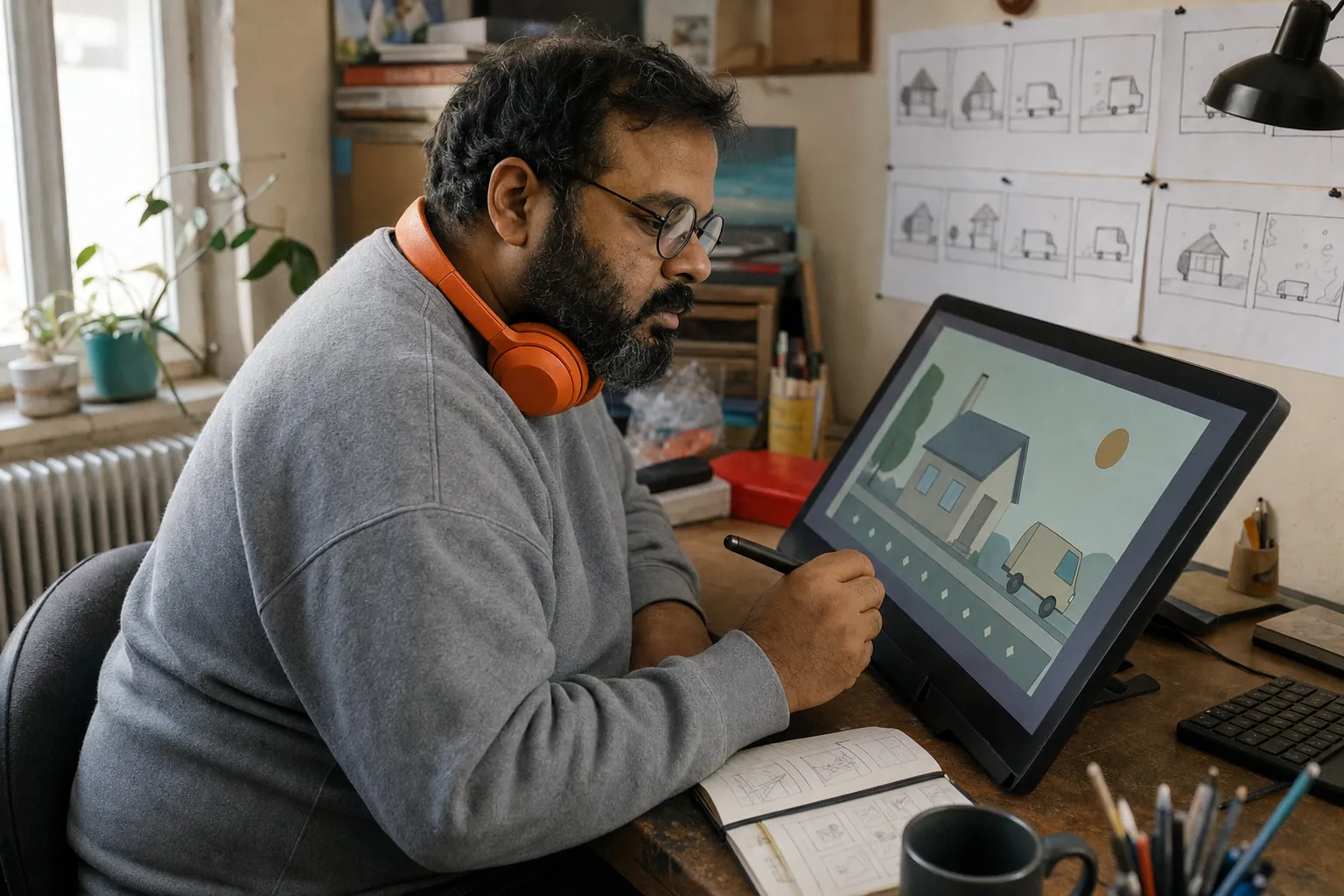
Can a business get marketing video made without a film crew?
Yes. A large share of useful marketing video is never filmed at all. Animated explainers, motion graphics and kinetic type, screen recordings of software or a booking process, and advertisements cut from photographs, existing footage and licensed stock are all made at a desk from a script and a storyboard.
That is the kind VIS Mountain produces. We do not send a crew and we do not shoot on location. What we build needs a script, your brand assets, whatever footage and photographs you already have, and the facts and evidence behind anything the video claims.
The result still needs captions, licensed music, correct claims and the right formats for where it will run, and those are part of the work rather than extras.
Written and maintained by the VIS Mountain team. Last reviewed . The sources behind it are listed below.
Built at a desk, not shot on a day
A filmed video costs a day of your premises, your staff and your patience, and it is out of date the moment a price, a name or a room changes. A built video costs none of those things and is changed by editing a file.
The sibling page on video editing covers the other case: you shoot on a phone, we cut it. This page is for the video that never needs shooting. An explainer of what happens during a procedure. A thirty second advertisement made from the photographs already on your website. A walkthrough of your online booking recorded from the screen. A recruitment piece built from type and motion because there is nothing to film.
For a local business this is often the better fit. Most of what a customer needs to understand is a process, a price structure or a reason to trust you, and those are explained more clearly by a diagram that moves than by a nervous person in a corridor.
The limit is equally plain. If the point of the video is a real person, a real room or a real result, that has to be captured by you, and this page becomes the editing page. We will tell you which one you need on the first call.
How a video gets made without a camera
The order matters. Nearly every expensive revision comes from starting at step four.
Decide the one job
Explain a procedure, answer the objection that stops people booking, show how the software works, or introduce the offer. A video that tries to do all four does none of them. The job decides the length, the format and where it runs.
Write the script, then check it
Every line is written before anything is drawn, because words are cheap to change and animation is not. The script goes back to you for a factual check: is this what actually happens, is this what it costs, is this how the treatment is described to a patient. Claims without evidence come out here, not after a platform review.
Storyboard it
A frame for each beat of the script, showing what is on screen and what is being said. This is the point to disagree, because everything after it is production. A storyboard approved by the person who owns the claims is the single biggest saver of time on this kind of work.
- What the viewer sees in each beat, and the caption line under it
- Where the logo, the phone number and the one action appear
- Which beats need reference material from you
See the remaining steps: How a video gets made without a cameraHide the remaining steps: How a video gets made without a camera
Gather the assets, with their rights
Your identity files, photographs, any footage on the camera roll, screen access for a walkthrough, and licensed stock for the gaps. Each piece is logged with where it came from and what licence covers it, so a video can be re-used in a year without anybody wondering whether it is safe to.
Build, voice and score it
Animation, motion type or screen capture assembled to the storyboard, then a recorded voice where the script needs one, and licensed music under it, mixed so speech stays clear. Sound is where built video most often looks cheap, and it is fixed here rather than in the final review.
Caption it, cut it to size, and hand it over
Captions written from the script and checked against the audio, then the cuts each placement needs: a tall version, a wide one, a square one, and short cuts for advertising. You receive the finished files plus the project source, so a price change next year is an edit and not a new project.
Changes are expected at the script and storyboard stages, where they are cheap. Changes after the build usually mean the job was not agreed at step one, and we will say so rather than keep animating.
The four kinds, and what each is made from
The right kind follows from what you already have and what the viewer has to understand.
| Item | Made from | Best for |
|---|---|---|
| Animated explainer | Illustration and a recorded voice, built to a script | A procedure, a process or a product nobody can film |
| Motion graphics and kinetic type | Your identity, words and simple shapes in motion | Offers, announcements, recruitment, anything with no imagery |
| Screen recording and walkthrough | Your software, portal or booking page, captured live | Showing exactly how something works, step by step |
| Ad cut from what exists | Your photographs, existing footage and licensed stock | Short advertising for social and video platforms |
Most businesses end up with one explainer that lasts years and short cuts made from it as offers change.
The placement decides the length
Google publishes the rules for its own video ad formats, and they are a useful discipline for any built video, even one that never runs as an ad.
SourceAbout video ad formats, Google Ads Help
Which is why a built video is written so the point lands in the opening seconds and the logo waits until the end. Nobody sits through a five second logo animation to find out what the video is about.
What you have to supply
None of this needs equipment. All of it needs somebody inside the business who can answer questions.
- The facts: what the service is, what it costs if the video says so, and what actually happens step by step. We write the script; you check it is true.
- Evidence for any claim the video makes, before it is drawn. A claim with no evidence is removed, not softened into a hint.
- Your logo files, colours and type, or the identity system if one exists, so the video looks like the rest of your material.
- Whatever footage and photographs you already have, with a note of who took them and whether you have the right to use them.
- Access to the software or booking page for a screen walkthrough, on a test account with no real customer data visible.
See the full checklist: What you have to supplyHide the full checklist: What you have to supply
- Written consent from anyone whose face, voice or name appears, which in healthcare means a formal authorisation rather than a verbal yes.
- A clinician's review of anything anatomical or medical, because we build those visuals from checked reference and the practice signs off on their accuracy.
- One person who can approve the storyboard and the final cut. Two approvers with different views is the most common cause of delay.
The first item is the one that slows projects down. A script cannot be checked by somebody who does not know the answer.
Licensing, captions and claims
Music is where built video most often goes wrong. The U.S. Copyright Office explains that a recorded song carries two separate copyrights, the musical work and the sound recording, which are commonly owned and licensed separately, so a licence for one is not a licence for both. Its own FAQ is equally plain that no rule permits using a set number of words or notes without permission. YouTube's Content ID scans every upload against a database of files submitted by copyright owners, and a match can block the video, monetise it by running ads against it, or track it. We use library music and stock under licences we can show you, and the terms travel with the project files.
Captions are an accessibility requirement, not a finishing touch. The W3C's Web Accessibility Initiative describes captions as a text version of the speech and the non-speech audio a viewer needs to understand the content, required at Level A of its guidelines for prerecorded video with audio. It also states that automatically generated captions do not meet accessibility requirements unless they are confirmed to be fully accurate, and that they usually need significant editing. Ours are written from the script and checked against the audio, and a good deal of social viewing is muted anyway.
Read the full breakdown: Licensing, captions and claimsHide the full breakdown: Licensing, captions and claims
Claims in video are claims. The Federal Trade Commission's rules on truthful, evidence-based advertising apply to a spoken line and an animated chart exactly as they apply to text. Testimonials carry more: an endorsement cannot be used to make a claim the business could not legally make itself, and where somebody appears because they were paid or given something, the Commission's guidance is that the disclosure belongs in the video, made at least visually, and at least audibly if the endorsement is spoken. A line in the description is not enough, because many people never see it.
Anatomy and medical visuals have to be correct. A dental or medical explainer is built from checked anatomical reference and reviewed by the clinician before release, because an invented cross-section of a tooth or a joint is a credibility problem with a patient and a liability with a regulator. Image generators produce plausible anatomy far more readily than accurate anatomy, and plausible is not the standard.
In healthcare, nothing in a video may confirm that a named or recognisable person is a patient without their written authorisation, and the practice remains responsible for its own compliance. We build to the stricter reading and point to the Department of Health and Human Services for the rules themselves.
When this is the wrong service, and how it is judged
It is wrong when the video only works with a real person in it. A surgeon's face, a plumber in a real crawlspace, a before and after that has to be trusted: those have to be captured by you, and the editing page is the one you need.
It is wrong when the business cannot supply the facts or the approver. A built video is only as good as its script, and a script nobody inside the business will check produces a polished version of a guess.
Read the full breakdown: When this is the wrong service, and how it is judgedHide the full breakdown: When this is the wrong service, and how it is judged
It is wrong as a first channel for a business with no traffic to show it to. An explainer earns its keep on a service page, in a retargeting campaign and in a reply to an enquiry, all of which assume something else is already working.
As for measurement, a video inherits it from where it runs. On a service page, whether enquiries from that page change. In advertising, the same cost per enquiry the campaign already reports, and view-through activity reported separately rather than blended in. On social, saves, shares and messages rather than views. Completion rate tells you whether the opening held attention, which decides what to make next and is not a business result.
We do not publish a price for this piece of work on its own, because the right scope depends on what already exists. What is published is the bundle pricing: 2,400, 3,600 or 4,800 dollars a month depending on which channels are running. You can read the full breakdown on the pricing page, and you will get an exact number in writing before anything starts.
How this connects to the rest
This sits under branding and creative beside video editing, and the two are deliberately separate. There, you shoot and we cut. Here, nothing needs shooting. Both apply the same brand identity so the result looks like the rest of your material.
It supplies creative to Meta ads and YouTube ads, where a short built cut is often the only way a business with no footage can run video at all, and where the formats above decide the lengths.
It feeds social media management and social content production with the tall cuts, and it gives web design the explainer that belongs at the top of a procedure page.
Where the video is a walkthrough of a booking flow or a portal, it overlaps with conversion rate optimization, because recording the flow for a video is often the moment the flow's own problems become visible.
Tell us the one thing your customers never quite understand.
That is the explainer. Send us the page or the phone script where you explain it today and we will tell you what kind of video it wants to be and what you would need to supply.
Straight answers.
Do you film anything at all?
No. VIS Mountain does not run a production crew and does not shoot footage on location, and we would rather say so than let you assume otherwise.
We build video from animation, motion graphics, screen recordings and material that already exists, and we edit the footage you shoot yourselves under the separate video editing service.
What do you need from us to start?
The facts and the evidence behind them, your identity files, any photographs or footage you already have with a note of the rights, and one person who can approve the storyboard.
For a screen walkthrough, access to a test account with no real customer data visible. For anything medical, a clinician willing to review the visuals.
Can you use the photographs already on our website?
If you have the right to. Photographs a photographer took for you are usually licensed for stated uses, and stock images bought for a website are not always licensed for video or advertising.
We check the licence for each asset before it goes into a build and log it with the project.
Can you use a popular song?
Not without licences for both the composition and the recording, which are separate copyrights, commonly owned and licensed separately. Platforms detect unlicensed music automatically, and the usual outcome is the video being blocked or muted after you have promoted it.
We use library music under licences we can show you, and we tell you what each licence covers.
Are captions really necessary?
Yes. The W3C's accessibility guidelines require captions on prerecorded video with audio at their most basic level, and automatic captions only count if they have been checked and corrected.
They also decide whether the video works at all on social platforms, where much of the viewing is muted.
Can you make medical or dental explainers?
Yes, and they are built from checked anatomical reference rather than generated imagery, with the clinician reviewing the visuals and the script before anything is released.
Outcome claims stay out, consent for anyone who appears is written, and the practice remains responsible for its own compliance with the health privacy rules.
Where this comes from.
Primary documentation and published research behind the guidance on this page.
- Captions and subtitles, Making Audio and Video Media Accessible, W3C Web Accessibility Initiative (opens in a new tab)Captions are required at WCAG Level A for prerecorded video, and automatic captions do not count unless checked.
- What Musicians Should Know about Copyright, U.S. Copyright Office (opens in a new tab)A song and its recording are separate copyrights, usually owned and licensed separately.
- How Content ID works, YouTube Help (opens in a new tab)Every upload is scanned against a database of copyright owners' files.
- The FTC's Endorsement Guides: What People Are Asking (opens in a new tab)
- FTC truth in advertising (opens in a new tab)
- About video campaigns, Google Ads Help (opens in a new tab)
Talk to the team
A short call, a look at how the business currently shows up, and a straight answer on what we would do first.
One build, several cuts, each with a day
A finished explainer is rarely posted once. It is cut down and scheduled.